DataOps: A Strategic Report on the Modern Data Management Paradigm
Executive Summary
In the contemporary enterprise, data is the most critical strategic asset, yet many organizations struggle to translate its potential into tangible value. Traditional data management practices, characterized by organizational silos, manual processes, and chronic bottlenecks, have proven inadequate for the volume, velocity, and variety of modern data. In response to this challenge, a new operational paradigm has emerged: DataOps. This report provides an exhaustive analysis of DataOps, intended for technology and business leaders seeking to understand its strategic importance and guide its implementation.
DataOps is a process-oriented methodology that systematically improves the quality and reduces the cycle time of data analytics. It achieves this by applying a powerful synthesis of principles from Agile development, DevOps, Lean Manufacturing, and Total Quality Management to the entire data lifecycle, from ingestion to insight delivery. It is not a single tool or technology but a holistic framework encompassing people, processes, and technology, designed to foster a culture of collaboration and continuous improvement. The core objective is to transform an organization’s data pipelines into a highly efficient, reliable, and automated “data factory” that consistently produces trusted, actionable insights aligned with business goals.
This report establishes several key findings. First, DataOps is fundamentally distinct from and more complex than its predecessor, DevOps. While it borrows core concepts like automation and CI/CD, it adapts them to address the unique challenges of data, which is stateful, prone to entropy, and has a variable quality that is non-deterministic, unlike software code. Second, the return on investment (ROI) from a successful DataOps implementation is significant and multifaceted, manifesting as improved data quality, radically accelerated time-to-insight, increased data team productivity and morale, and mitigated operational and compliance risks. Third, the most formidable barrier to DataOps adoption is not technological but cultural. The success of any DataOps initiative hinges on an organization’s ability to dismantle entrenched silos and foster genuine collaboration among a diverse group of stakeholders, including data engineers, scientists, analysts, and business users. Finally, the trajectory of DataOps is inextricably linked to the rise of artificial intelligence (AI). It serves as the foundational layer for MLOps and AIOps and is evolving in tandem with decentralized architectural patterns like the Data Mesh.
For leaders contemplating this journey, the strategic recommendations are clear. DataOps must be treated as a fundamental cultural transformation, not merely a technical project. Its implementation should be championed with strong executive sponsorship and initiated with a well-defined scope, focusing on a high-value data product to demonstrate early success. Ultimately, investment must be balanced, addressing not only the acquisition of a modern DataOps toolchain but also the critical upskilling and realignment of the people who will power this new data paradigm.
The Genesis and Evolution of DataOps: From Concept to Mandate
The emergence of DataOps was not a singular event but an evolutionary response to the growing crisis in data analytics. As organizations became inundated with data, the traditional, project-based methods for delivering insights proved too slow, brittle, and unreliable. The gap between business demand for analytics and the data team’s ability to deliver widened into a chasm. To bridge this gap, pioneers began synthesizing proven methodologies from other disciplines, creating a new framework tailored to the unique challenges of the data domain.
The Origins of the Term
The term “DataOps” first appeared in the technology lexicon on June 19, 2014. It was introduced by Lenny Liebmann, a contributing editor for InformationWeek, in a blog post on the IBM Big Data & Analytics Hub titled “3 reasons why DataOps is essential for big data success”.1 While Liebmann planted the seed, the concept was cultivated and popularized by a community of forward-thinking practitioners.
Figures like Andy Palmer of Tamr and data strategist Steph Locke were instrumental in evangelizing the methodology, giving it shape and momentum.1 Palmer, in particular, is often credited with defining the Pascal-cased “DataOps” around 2015, describing it as the critical intersection of data engineering, data integration, data quality, and data security, all unified by a collaborative culture.5 This early work distinguished DataOps as more than just a buzzword, framing it as a comprehensive approach to increase the velocity, reliability, and quality of data analytics.7
The Intellectual Heritage: A Synthesis of Proven Methodologies
A core reason for the robustness and efficacy of DataOps is that it is not a monolithic invention. Instead, it is a powerful amalgamation of principles drawn from several mature and battle-tested disciplines. This synthesis was necessary because the challenges of managing data are multifaceted and could not be solved by a single approach.8
- DevOps: This is the most prominent ancestor of DataOps. From DevOps, it inherits the core philosophy of breaking down organizational silos to foster collaboration between teams responsible for development and operations. DataOps adapts this by expanding the collaborative scope to include data scientists, analysts, engineers, and business stakeholders. It also heavily borrows the technical practices of automation, especially Continuous Integration and Continuous Deployment (CI/CD), to accelerate the delivery of data products.2
- Agile Methodology: Where DevOps provides the operational mechanics, Agile provides the development philosophy. DataOps applies Agile principles to shorten the analytics development lifecycle. Instead of long, monolithic projects, data teams work in short, iterative cycles or “sprints.” This allows them to deliver value to the business early and often, gather feedback, and continuously adapt to changing requirements—a crucial capability in the fluid world of data exploration and business intelligence.11
- Lean Manufacturing: This discipline contributes the powerful metaphor of the “data factory.” DataOps views the end-to-end process of creating analytics—from raw data to insight—as a manufacturing line. The goal, borrowed from Lean, is to maximize value while eliminating waste, redundancy, and bottlenecks. This is achieved by creating simple, standardized, and highly automated processes that ensure a smooth and efficient flow through the data pipeline.9
- Total Quality Management (TQM) and Statistical Process Control (SPC): This is perhaps the most critical addition that distinguishes DataOps from a simple adaptation of DevOps. Given that data quality is variable and paramount, DataOps incorporates TQM principles to build quality into every step of the process. Specifically, it utilizes Statistical Process Control (SPC) to continuously monitor the data analytics pipeline. By tracking key metrics and ensuring they remain within statistically acceptable ranges, teams can proactively detect anomalies and quality issues before they corrupt downstream analytics. This relentless focus on quality control is essential for building trust in the data factory’s output.2
The necessity of this multi-disciplinary heritage stems from the fundamental nature of data itself. A direct application of DevOps principles alone is insufficient because software code and data are inherently different assets. Code is a human-created, deterministic, and largely stateless artifact. A software build is a predictable process. Data, in contrast, is often machine-generated, represents a stateful snapshot of the real world, is prone to entropy and degradation (data drift), and its quality is often unpredictable. The manufacturing analogies from Lean and TQM are essential for managing the “flow” and “quality control” of this stateful asset. The Agile component is required to handle the exploratory and often ambiguous nature of analytics requests, which differ greatly from the well-defined feature requirements in software development. This complex intellectual foundation explains why implementing DataOps is a significant organizational undertaking, demanding a broader cultural shift than DevOps. It involves a more diverse set of roles and addresses a more complex set of challenges, blending process engineering with collaborative work culture.
The DataOps Manifesto: Codifying the Core Principles
To formalize its core tenets, the community developed the DataOps Manifesto, a set of 18 principles that serve as a guiding light for the methodology.14 These principles provide a concrete framework for organizations to assess their practices and culture. They can be grouped into four key themes:
Value and Customer Focus
- 1. Continually satisfy your customer: The highest priority is the early and continuous delivery of valuable analytic insights.
- 2. Value working analytics: The primary measure of performance is the delivery of insightful analytics built on accurate data and robust systems.
- 3. Embrace change: Welcome evolving customer needs as an opportunity for competitive advantage.
Team and Culture
- 4. It’s a team sport: Recognize that analytic teams are composed of diverse roles and skills, and this diversity drives innovation.
- 5. Daily interactions: Foster daily collaboration between customers, analytic teams, and operations.
- 6. Self-organize: The best designs, algorithms, and insights emerge from self-organizing teams.
- 7. Reduce heroism: Strive to create sustainable and scalable processes, reducing reliance on individual “heroes” to fix problems.
- 8. Reflect: Regularly reflect on performance and customer feedback to fine-tune operations.
Technology and Code
- 9. Analytics is code: Treat all artifacts that configure and process data (e.g., SQL scripts, model configurations) as source code.
- 11. Make it reproducible: Version everything—data, code, and environment configurations—to ensure results are reproducible.
- 12. Disposable environments: Minimize the cost of experimentation by providing easy-to-create, isolated, and disposable technical environments.
Process and Operations
- 10. Orchestrate: The end-to-end orchestration of data, tools, code, and teams is a key driver of success.
- 13. Simplicity: Maximize the amount of work not done; simplicity is essential.
- 14. Analytics is manufacturing: Apply process-thinking to achieve continuous efficiencies in the production of analytics.
- 15. Quality is paramount: Build pipelines with automated detection of abnormalities and continuous feedback to prevent errors.
- 16. Monitor quality and performance: Continuously monitor metrics to detect unexpected variation and generate operational statistics.
- 17. Reuse: Avoid repeating previous work to maximize efficiency.
- 18. Improve cycle times: Always work to minimize the time from customer need to delivered, reusable analytic product.
This manifesto is more than a philosophical statement; it is a practical guide. For leadership, these principles provide a concrete checklist for evaluating and driving the necessary cultural and operational shifts, transforming the abstract goal of “adopting DataOps” into a set of measurable actions.
Market Maturation and Recognition
While its conceptual roots date back to 2014, DataOps began to gain significant industry traction around 2017. This period saw a marked increase in ecosystem development, vendor offerings, and analyst coverage.2
A pivotal moment in its maturation came in 2018 when the influential technology research firm Gartner included DataOps in its Hype Cycle for Data Management.2 This inclusion served as a powerful signal to the market, validating DataOps as a legitimate and critical trend that enterprise leaders needed to address.
The momentum has continued to build, with strong forecasts for market growth. One projection indicates that the global DataOps platform market is expected to reach US $10.9 billion by 2028, underscoring the sustained and significant investment organizations are making in this paradigm.9 This trajectory reflects a broad recognition that in an economy driven by data, the ability to rapidly and reliably produce analytics is no longer a competitive advantage but a fundamental requirement for survival.
Defining DataOps: A New Paradigm for Data Management
At its heart, DataOps represents a fundamental shift in how organizations approach the entire lifecycle of their data. It moves away from a traditional, project-based, and often chaotic model toward a process-oriented, product-centric, and highly disciplined approach. It is a methodology designed to manage the complexity and scale of modern data while aligning data analytics efforts directly with business outcomes.
A Formal Definition
DataOps is a set of practices, processes, and technologies that combines an integrated and process-oriented perspective on data with automation and methods from agile software engineering to improve the quality, speed, and collaboration in the area of data analytics.2
Crucially, DataOps is not a single technology that can be purchased off the shelf. It is a holistic methodology that encompasses the three pillars of transformation:
- People: Fostering a culture of collaboration and shared responsibility among all data stakeholders.
- Process: Implementing agile, iterative, and automated workflows across the data pipeline.
- Product: Treating data and analytics as strategic business assets that are developed, delivered, and managed with rigor.8
The ultimate aim is to transform massive amounts of raw data into a reliable, strategic asset that drives business value.8
Core Objectives: The “Why” of DataOps
The adoption of DataOps is driven by a clear set of strategic objectives designed to address the most pressing challenges in modern data management.
- Improve Quality, Speed, and Reliability: The primary goal is to simultaneously enhance the quality of data, the speed (velocity) at which it is delivered, and the reliability of the entire data analytics pipeline. This trifecta is essential for unlocking the full business value of an organization’s data assets.2
- Shorten Time-to-Insight: DataOps seeks to radically shorten the development cycle time for analytics. By applying Agile and automated principles, it aims to reduce the time from an initial business question or data need to the delivery of a valuable insight from months or weeks down to days or even hours.2
- Foster a Culture of Continuous Improvement: DataOps is not a one-time project but a commitment to an ongoing process of refinement. It establishes a culture of continuous improvement, communication, and collaboration among all data stakeholders, from engineers and scientists to the ultimate business consumers of the data.2
The Problems DataOps Solves
DataOps emerged as a direct solution to a set of chronic and deeply painful problems that have long plagued enterprise data and analytics efforts.
- Data Silos: In most organizations, data is fragmented. It is created by one group (e.g., an operational system), managed by another (IT), and consumed by many others (analysts, data scientists, business leaders). This creates organizational silos that prevent a unified view of data and hinder collaboration. DataOps systematically breaks down these walls by creating cross-functional teams and shared processes, bridging the gap between data creators, managers, and consumers.11
- Pipeline Bottlenecks: Traditional data pipelines are often brittle, manual, and slow. They become easily clogged when faced with urgent or unforeseen business demands for new analytics. The volume, velocity, and variety of modern data have overwhelmed these legacy approaches. DataOps addresses this by orchestrating and automating the end-to-end data analytics pipeline, ensuring efficiency, scalability, and the removal of critical bottlenecks.8
- Inconsistent Data Quality and Lack of Trust: Perhaps the most critical problem DataOps solves is the crisis of confidence in enterprise data. When data quality is poor or inconsistent, business leaders lose trust in the analytics derived from it. Decisions are delayed, or worse, made on faulty information. DataOps makes data quality a first-class citizen. By embedding automated testing, validation, and continuous monitoring throughout the entire data lifecycle, it catches errors early and prevents poor-quality data from reaching consumers. This systematic focus on quality is the primary mechanism for building and maintaining trust in the data.11
- Slow Time-to-Value: The lengthy cycle times of traditional data projects mean that by the time an analytic report is delivered, the business opportunity may have already passed. By accelerating development cycles through automation and Agile methods, DataOps enables organizations to generate and act on insights much faster, creating a significant competitive advantage.4
The recurring emphasis on building “trust” in data reveals a deeper motivation behind the DataOps movement. The methodology is not merely about making data pipelines faster or more efficient; it is about making them trustworthy. The proliferation of data sources has led to a corresponding explosion in data quality issues, creating a pervasive sense of uncertainty among business decision-makers. They are hesitant to act on data they cannot rely on. DataOps directly confronts this crisis of confidence. Core components like automated testing, data observability, and embedded governance are not optional add-ons; they are integral parts of the framework designed to systematically prove the reliability of the data. This focus on trust is what elevates DataOps from a technical optimization to a strategic business imperative. Furthermore, this foundation of trust is a non-negotiable prerequisite for any organization aspiring to leverage more advanced, high-stakes technologies like artificial intelligence and machine learning. An AI model is fundamentally a product of the data it is trained on. Without the reliable, high-quality, and governed data pipelines that a mature DataOps practice provides, any large-scale MLOps or AIOps initiative will inevitably fail due to the “garbage in, garbage out” principle. Therefore, DataOps is not just an enabler of better analytics; it is the essential foundation for the future AI-driven enterprise.
The DevOps Heritage: How DataOps Adapts and Diverges
The name “DataOps” clearly signals its lineage from DevOps, the revolutionary methodology that transformed software development. Understanding this relationship—both the powerful similarities and the critical distinctions—is essential for grasping the unique nature and challenges of DataOps. While it is often described as “DevOps for data,” this simplification overlooks the significant adaptations required to handle the complexities of the data domain.
Shared Philosophy and Foundations
DataOps and DevOps are built upon the same philosophical bedrock, sharing several core principles that drive their effectiveness.
- Agile Principles: Both methodologies are rooted in the Agile philosophy of accelerating work cycles. They prioritize iterative development, continuous feedback, and adaptability to deliver value quickly and reliably.17
- Breaking Down Silos: The foundational goal of both is to eliminate the walls between functional teams. DevOps famously bridges the gap between software Development (Dev) and IT Operations (Ops). DataOps extends this concept to a much broader ecosystem, fostering collaboration among data engineers, data scientists, analysts, business users, and IT operations.17
- Automation and CI/CD: Both rely heavily on automation to improve speed, reduce human error, and ensure consistency. Specifically, they both leverage Continuous Integration/Continuous Deployment (CI/CD) pipelines as the central mechanism for automatically testing and releasing their respective products—software applications for DevOps, and data products for DataOps.19
Critical Distinctions: Why DataOps is Not Just “DevOps for Data”
Despite their shared heritage, applying DevOps practices directly to data without modification is a recipe for failure. The nature of data is fundamentally different from that of software code, necessitating a distinct and more complex methodology. The following table provides a detailed comparison of the two disciplines across several key dimensions.
Table: DataOps vs. DevOps – A Detailed Comparison
| Aspect | DevOps | DataOps |
| Primary Goal | Faster, more reliable delivery of high-quality software applications.8 | Faster, more reliable delivery of high-quality, trusted data and analytics to drive business decisions.8 |
| Core “Raw Material” | Code (human-generated, deterministic, stateless). | Data (machine/human-generated, non-deterministic, stateful, has entropy).17 |
| Key Teams Involved | Software Developers, IT Operations, QA Engineers.17 | Data Engineers, Data Scientists, Analysts, Business Users, IT Operations, Data Stewards.11 |
| Primary Deliverables | Software applications, mobile apps, system updates.17 | Data products, analytics reports, BI dashboards, trained ML models, curated datasets.19 |
| Nature of Operations | Operations are generally repeatable, highly similar cycles for software builds and deployments.17 | Operations must constantly address new and changing data challenges involving many sources, formats, and unpredictable quality issues.17 |
| Technology Stack | CI/CD tools (Jenkins, Git), containerization (Docker, Kubernetes), configuration management.26 | Data integration (Talend, Fivetran), orchestration (Airflow), transformation (dbt), observability (Monte Carlo), data warehouses/lakes.26 |
| Approach to Quality | Focus on delivering a quality end product with minimal bugs.17 | Must ensure high-quality data enters the process and that the trusted output is used appropriately by the business. Quality is a continuous concern throughout the pipeline.17 |
| Key Metrics | DORA Metrics: Deployment Frequency, Lead Time for Changes, Mean Time to Recovery (MTTR), Change Failure Rate.26 | Pipeline Performance, Data Quality (error rates), Delivery Timeliness, Data Downtime, Issue Resolution Time.22 |
The core technical principle that underpins these distinctions is the concept of state. DevOps primarily deals with stateless application code. Code can be versioned, deployed, and rolled back in a predictable manner because the application itself does not have a “state” in the same way a dataset does. A dataset, however, is inherently stateful; it is a snapshot of reality at a particular moment in time. Its state is its very essence. Rolling back a change in a data pipeline is far more complex than rolling back a code deployment, as it may require intricate data remediation to correct the state of the data.
This fundamental difference in handling state explains the need for data-specific practices and tools. Data lineage, for instance, is a critical concept in DataOps for tracing the state of data as it flows and transforms through the pipeline. The pillars of data observability, such as “Freshness” and “Volume,” are direct measures of the data’s state and health. This statefulness also means that risk is distributed differently. In DevOps, risk is often concentrated at the point of deployment. In DataOps, risk is continuous and pervasive. A data quality issue can be introduced at any time—at ingestion, during transformation, or from an unexpected schema change in a source system. This reality necessitates a culture of constant vigilance and proactive monitoring, rather than one focused solely on gatekeeping at release points. It requires a much tighter and more continuous feedback loop between the engineers who manage the pipeline and the business users who are often the first to sense when the data “feels wrong.”
The Role of Observability: An Adapted Concept
The concept of observability is central to both disciplines, but its focus and implementation are adapted to their respective domains.
- DevOps Observability: Focuses on understanding the internal state and health of applications from external outputs. It relies on the “three pillars” of logs (records of events), metrics (numeric measurements over time), and traces (records of related events in a distributed system) to predict and triage application downtime.19
- Data Observability: Adapts this concept to focus on the health of the data itself. It is defined as an organization’s ability to fully understand the health of the data in its systems and to reduce data downtime (periods when data is partial, erroneous, or inaccurate). It has its own set of data-centric pillars 19:
- Freshness: Is the data up-to-date? When was it last refreshed?
- Distribution: Is the data within expected statistical ranges? Are there unexpected nulls or outliers?
- Volume: Has the expected amount of data arrived? Are there duplicates or missing records?
- Schema: Has the structure of the data (e.g., tables, columns, data types) changed?
- Lineage: What are the upstream data sources and downstream dependencies of a given data asset? Understanding lineage is crucial for root cause analysis and impact assessment.
By continuously monitoring these pillars, DataOps teams can move from reactive firefighting to proactive management of data quality and reliability.
The DataOps Framework in Practice: People, Processes, and Technology
A successful DataOps implementation is not about buying a new tool; it is about adopting a holistic framework that integrates people, processes, and technology into a cohesive, high-performance system. Each of these three components is essential, and weakness in one will undermine the entire initiative. The goal is to create an environment where data can be transformed into value with maximum speed and minimum friction.
The People: Fostering a Collaborative Data Culture
The foundation of DataOps is a cultural shift. Technology and processes are enablers, but without the right culture, they will fail to deliver their potential. The primary focus is on breaking down the organizational silos that have traditionally separated the people who create, manage, and consume data.8
This is achieved by creating cross-functional teams that bring together all the necessary expertise to deliver a data product from end to end. A typical DataOps team includes data engineers, data scientists, data analysts, IT/operations staff, and—most importantly—business stakeholders.11 The inclusion of business users is non-negotiable, as it ensures that the work of the data team is constantly aligned with tangible business goals and that feedback is rapid and relevant.
This collaborative model also requires a change in mindset. The culture must move away from “heroism,” where a few key individuals are relied upon to firefight and solve all problems. This approach is not scalable and leads to burnout. Instead, DataOps promotes a culture of shared responsibility, where quality is everyone’s job, and the focus is on building sustainable, scalable, and automated processes that reduce the need for heroic interventions.14
The Processes: The DataOps Lifecycle
DataOps applies a structured, iterative, and automated set of processes to the entire data lifecycle, from initial data preparation to the final delivery of analytics and reports.2 The framework organizes this lifecycle into four core processes 8:
- Data Integration: This involves creating a unified view of organizational data, which is often fragmented across dozens or hundreds of different systems. The goal is to build seamless, automated, and scalable data pipelines (using ETL/ELT patterns) to find and integrate the right data without losing context or fidelity.
- Data Management: This process focuses on automating and streamlining workflows throughout the data’s life, from its creation to its archival or deletion. Agility and responsiveness are key, ensuring that the management processes can adapt to new data sources and changing requirements.
- Data Analytics Development: This is the process of creating value from the data. It enables the rapid, iterative development of optimal and reusable analytics models, user-centric data visualizations, and other data products. It emphasizes continuous innovation to improve these models over time.
- Data Delivery: The final step is ensuring that all business users can access the data and analytics they need, when they need it most. This goes beyond efficient storage to include democratized, self-service access options that empower users to find their own answers.
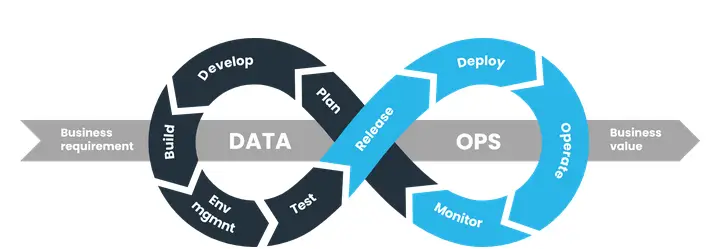
This entire set of processes is executed in an iterative lifecycle inspired by DevOps but adapted for the unique characteristics of data. A typical DataOps workflow looks like this 19:
- Plan: The cycle begins with close partnership between the data team and business stakeholders to define requirements, establish key performance indicators (KPIs), and agree on data quality standards.
- Develop/Integrate/Test: Data engineers and scientists work in isolated, disposable development environments to build and modify data pipelines, transformations, and models. All changes are subjected to rigorous, automated testing.
- Release/Deploy: Once tested and approved, changes are merged into the production environment using automated CI/CD pipelines.
- Operate/Monitor: The data flows through the production pipelines into end-user applications like BI dashboards and machine learning models. The health of both the pipeline and the data itself is continuously monitored through data observability platforms, with automated alerts for any anomalies or quality issues.
The Technology: Architectural Pillars of DataOps
While DataOps is a methodology first and foremost, it is enabled by a specific set of technological capabilities. It is technology-agnostic in that it does not mandate specific tools, but a mature DataOps implementation will invariably be built upon the following architectural pillars 2:
- Data Orchestration: This is the engine of the data factory. Orchestration tools automate the end-to-end management of data workflows, scheduling tasks, managing dependencies between processes, and ensuring that data moves efficiently through the pipeline from ingestion to delivery.25
- Data Governance: This pillar ensures that data is managed as a secure and trustworthy asset. It involves establishing and enforcing policies, procedures, and standards for data quality, data security, and privacy compliance (e.g., GDPR, CCPA). Governance tools help automate data quality management, implement access controls, and maintain an audit trail.11
- Continuous Integration/Continuous Deployment (CI/CD) for Data: This is a direct adaptation from DevOps. It involves using version control systems (like Git) for all data-related artifacts (ETL code, SQL transformations, data models, environment configurations). This enables teams to track all changes and collaborate effectively. CI/CD pipelines then automate the build, testing, and deployment processes, allowing for rapid, frequent, and reliable releases of new data products.25
- Data Observability and Monitoring: This provides end-to-end visibility into the entire data ecosystem. Observability platforms continuously monitor the health of data pipelines and the data flowing through them, using machine learning to detect anomalies and alert teams to issues like freshness delays, volume discrepancies, or schema changes, often before they impact downstream users.19
- Automation: This is the foundational capability that underpins all other pillars. Automation is used pervasively to streamline repetitive tasks, reduce the potential for human error, and enable the entire framework to scale effectively.11
One of the most powerful but often underappreciated technical enablers of the DataOps culture is the principle of disposable environments.14 In traditional data development, standing up a new environment for testing or experimentation is often a slow, bureaucratic, and expensive process that requires significant IT involvement. This high cost of experimentation creates a powerful disincentive for innovation; data scientists and engineers are hesitant to try new things for fear of breaking something or wasting time. By leveraging modern technologies like infrastructure-as-code and containerization (borrowed from DevOps), a mature DataOps practice allows team members to spin up isolated, safe, and production-like environments in minutes, and then tear them down just as easily. This technical capability has a profound cultural impact: it makes failure cheap. It directly empowers the “embrace change” and “self-organize” principles of the manifesto by creating a safe space for innovation. It is a key mechanism that translates the philosophy of agility into the daily, practical reality of the data team. This demonstrates that a successful DataOps initiative cannot be a piecemeal effort. Simply purchasing an orchestration tool (Technology) without changing how teams collaborate (People) or how work is managed (Process) will not yield the promised benefits. It requires a coordinated, top-down strategic program, championed by a leader who understands and can articulate this holistic vision.
The DataOps Technology Ecosystem: Tools for a Modern Data Stack
DataOps is not a monolithic platform that can be purchased from a single vendor. Instead, it is a methodology enabled by a “toolchain”—a collection of specialized tools, both commercial and open-source, that are integrated to manage the end-to-end data lifecycle.2 Understanding the key categories of tools and how they fit together is crucial for designing and implementing a modern, effective data stack.
Methodology over Monolith
The guiding principle of a DataOps architecture is to select the best tool for each specific job and orchestrate them into a cohesive workflow. This approach provides flexibility and avoids the limitations of a single, all-in-one solution. As organizations mature, they assemble a DataOps toolchain that meets their specific needs for scale, performance, and governance.
The DataOps Toolchain by Function
The vast landscape of DataOps tools can be organized into several logical categories based on their function within the data pipeline. The following table provides a structured map of this ecosystem, highlighting key functions and representative tools.
Table: The DataOps Technology Stack by Function
| Category | Function | Commercial Examples | Open-Source Examples |
| Data Integration / Ingestion | Moving data from various source systems (databases, APIs, files) into a centralized platform like a data warehouse or data lake. | Rivery, Fivetran, StreamSets (IBM), Matillion, Talend, Stitch | Airbyte |
| Data Storage | Storing and providing access to large volumes of structured and semi-structured data in a scalable, performant manner. | Snowflake, Amazon Redshift, Google BigQuery, Databricks Lakehouse | |
| Data Transformation | Cleaning, modeling, combining, and preparing raw data to make it ready for analysis. This is where business logic is applied. | dbt Cloud (Data Build Tool) | dbt Core |
| Data Pipeline Orchestration | Managing, scheduling, monitoring, and automating the end-to-end data workflow, ensuring tasks run in the correct order. | DataKitchen, Astronomer (Astro), Prefect | Apache Airflow, Dagster, Luigi |
| Data Quality & Observability | Proactively monitoring data pipelines and the data itself for quality issues, drift, schema changes, and other anomalies. | Monte Carlo, Unravel, Soda, RightData, Badook | Great Expectations |
| Data Governance & Catalog | Managing data access, security, and compliance. Providing a searchable, collaborative catalog of all data assets with rich metadata. | Alation, Collibra, Immuta, Ketch, IBM Watson Knowledge Catalog | |
| Version Control | Tracking all changes to code and configuration files (e.g., SQL scripts, dbt models, orchestration DAGs) to enable collaboration and reproducibility. | GitHub, GitLab, Bitbucket | Git |
| Business Intelligence (BI) | The final layer where business users consume the data through interactive dashboards, reports, and visualizations. | Tableau, Power BI, Looker, QlikView |
The emergence and widespread adoption of dbt (data build tool) marks a particularly pivotal moment in the evolution of the modern data stack. It effectively unbundled the “T” (Transformation) from the traditional, monolithic ETL (Extract, Transform, Load) process. Historically, transformation logic was often locked within the GUI of a specific ETL tool, making it difficult to version control, test, and reuse. dbt changed this by allowing teams to write their transformations in simple SQL, manage that SQL as code in a Git repository, and apply software engineering best practices—such as automated testing and CI/CD—directly to the data modeling process. This “analytics is code” approach is the very heart of the DataOps philosophy.30 The rise of
dbt empowered a new role, the “analytics engineer,” who sits at the intersection of data engineering and business analysis, and it firmly established the transformation layer as a distinct, modular, and highly disciplined part of the data stack.
This modular structure of the modern DataOps toolchain—with distinct, best-of-breed tools for ingestion, storage, transformation, orchestration, and observability—is not a coincidence. It closely mirrors the microservices architecture that has become dominant in modern software engineering. This architectural parallelism reflects a fundamental industry shift away from opaque, monolithic systems toward more transparent, manageable, and agile ecosystems. For leaders, this has a clear implication for hiring and team development: the skills required for modern data engineering are rapidly converging with those of modern software engineering. Competencies in APIs, modular design, version control, automated testing, and distributed systems are becoming just as important as traditional data modeling and SQL skills.
Platform vs. Best-of-Breed
While the best-of-breed approach offers maximum flexibility, a counter-trend has emerged with the rise of unified DataOps platforms. Vendors like DataKitchen, Databricks, and Rivery aim to provide multiple functions of the toolchain within a single, integrated solution. The strategic choice between these two models involves a classic trade-off. A unified platform can offer greater ease of use, faster setup, and simplified vendor management. However, a best-of-breed approach provides the flexibility to choose the absolute best tool for each specific function and avoid vendor lock-in. The right strategy depends on an organization’s size, existing technology stack, and the specific skills of its data team.
Pioneers and Practitioners: DataOps Implementation Case Studies
The principles of DataOps are not merely theoretical; they have been successfully implemented by a wide range of organizations, from data-native technology giants to established enterprises across diverse industries. These case studies provide concrete evidence of the methodology’s value and offer practical insights into its application.
Data-Native Pioneers
The earliest adopters of DataOps principles were often large, data-intensive technology companies that were forced to invent new ways to manage data at an unprecedented scale.
- Netflix: As one of the world’s largest streaming services, Netflix’s entire business model relies on data. It leverages DataOps practices to manage the petabytes of data that fuel its sophisticated content recommendation engine, optimize video streaming quality in real-time, and create deeply personalized user experiences. The company relies heavily on automated data pipelines and robust CI/CD processes to continuously scale its massive data infrastructure and deliver timely insights to millions of subscribers globally.16
- Airbnb: The online marketplace for lodging collects vast amounts of data from hosts, guests, and properties. To manage this complexity, Airbnb adopted DataOps practices such as version-controlled data pipelines and automated testing frameworks. This has allowed the company to effectively scale its data infrastructure while maintaining the high levels of data integrity and reliability required to power its dynamic pricing algorithms, search rankings, and user recommendations.19
- Uber: Another pioneer in the data-first economy, Uber uses DataOps to manage its immense, real-time data streams. These principles are essential for orchestrating the complex logistics of its ride-hailing and delivery services, optimizing dynamic pricing, and ensuring service reliability across its global operations.16
Cross-Industry Adoption
The success of the data-native pioneers has inspired broader adoption, demonstrating that DataOps principles are applicable far beyond Silicon Valley.
- Financial Services (Capital One): The leading bank implemented DataOps to enhance data-driven decision-making across critical business functions, including risk management, marketing, and customer service. A key focus of their implementation was establishing a strong culture of data governance. By using DataOps practices like creating a comprehensive data catalog and implementing granular access controls, Capital One has successfully treated its data as a strategic, accountable asset, ensuring both security and utility.33
- Healthcare (Boston Children’s Hospital): The renowned hospital was facing significant challenges with fragmented data systems that impeded critical research efforts and hindered effective clinical decision-making. By adopting a DataOps approach, the hospital implemented a unified, cloud-based data lake and automated its data pipelines to integrate and clean data from disparate sources, creating a single source of truth. The results were dramatic: a 40% reduction in research lead time, a 12% improvement in patient medication adherence, and the ability to more rapidly diagnose and treat rare diseases.9
- Retail (HomeGoods Plus): This mid-sized retailer was struggling with slow and reactive data pipelines that severely limited its marketing agility. The marketing team had to wait up to a week to receive consolidated sales data, making it impossible to adjust campaigns in a timely manner. By implementing a DataOps strategy that included an automated data integration platform, orchestration tools, and real-time monitoring, HomeGoods Plus transformed its capabilities. The time-to-insight was reduced from a week to mere minutes. This enabled the marketing team to immediately identify successful campaigns and reallocate resources, resulting in a 15% increase in campaign effectiveness and a 10% boost in sales within the first quarter.33
- Manufacturing (General Electric): GE adopted a DataOps framework to manage and analyze the complex streams of industrial data generated by Internet of Things (IoT) sensors across its manufacturing units. This implementation was crucial for improving operational efficiency, enabling predictive maintenance, and optimizing production processes.35
Vendor and Partner Success Stories
The growing DataOps ecosystem has also produced compelling case studies where vendors help their clients achieve significant results.
- Snowflake: The data cloud company itself used the DataOps.live platform to build an internal “solutions marketplace” for its global technical sales team. The goal was to automate and streamline the process of creating tailored, innovative, and impactful product demos for customers. The DataOps implementation allowed them to reduce demo deployment time from hours to minutes. The project, built in under 45 days, was estimated to deliver a benefit of $24.3 million over three years through time savings, efficiency gains, and product revenue growth.36
- Johnson & Johnson: The pharmaceutical giant utilized the Datacoves platform as a “framework accelerator” to implement DataOps. This allowed them to deploy automation tailored specifically to their complex needs within the highly regulated pharmaceutical sector, speeding up their data evolution.37
A clear pattern emerges from these diverse case studies. Successful DataOps adoption rarely begins as a massive, enterprise-wide “big bang” initiative. Instead, it typically starts with a focus on a specific, high-impact business problem where the pain of the status quo is acute and the potential ROI is clear. For HomeGoods, it was slow marketing reports; for Boston Children’s Hospital, it was fragmented research data. The tangible, measurable success achieved in that initial use case—such as a “15% increase in campaign effectiveness”—then serves as a powerful internal catalyst. It provides the proof of concept needed to win over skeptics, secure further investment, and build the organizational momentum required for a broader, more strategic rollout. This approach aligns perfectly with the Agile principle of delivering value in small, iterative increments, proving the methodology’s worth before demanding a large-scale transformation.
This diversity of industries also demonstrates the universal applicability of DataOps principles. However, it also highlights that the specific implementation details and choice of tools are highly context-dependent. A bank like Capital One will rightly prioritize governance and security, while a retailer will focus on real-time streaming analytics. This implies that there is no single “correct” way to implement DataOps. A successful strategy must be carefully tailored to the organization’s unique industry, regulatory landscape, and specific business objectives.
Navigating the Path to Adoption: Benefits, Challenges, and Strategic Recommendations
Adopting DataOps is a transformative journey that promises substantial rewards but also presents significant hurdles. For leaders, a clear-eyed understanding of the business case, a realistic assessment of the challenges, and a well-defined strategic plan are essential for navigating this path successfully. The goal is to move from a state of high organizational friction in data processes to one of smooth, automated, and value-driven flow.
The Business Case: Quantifiable Benefits of DataOps
The return on investment from a mature DataOps implementation is compelling and manifests across multiple dimensions of the business.
- Improved Data Quality and Trust: This is the most foundational benefit. By embedding automated quality checks, continuous monitoring, and clear governance into the data lifecycle, DataOps produces data that is demonstrably more accurate, consistent, and reliable. This, in turn, builds crucial trust among business users, encouraging data-driven decision-making.19
- Faster Time-to-Insight and Value: By streamlining and automating data pipelines, DataOps dramatically shortens the cycle time for delivering analytics. This allows organizations to respond much more quickly to market changes, customer needs, and competitive threats. An IDC survey highlighted this impact, finding that successful DataOps implementation led to a 49% decrease in the frequency of late delivery for analytics products.19
- Increased Productivity and Efficiency: The pervasive use of automation for repetitive and manual tasks—such as data ingestion, cleansing, testing, and pipeline management—frees data professionals from low-value “firefighting.” This allows them to focus their expertise on higher-value activities like innovation, strategic analysis, and collaboration with the business. The result is not only increased efficiency but also higher team morale and retention.19
- Reduced Operational Costs and Risk: Automation directly reduces costs by minimizing human error and optimizing the use of computational resources. This can lead to a significant reduction in the Total Cost of Ownership (TCO) of the data stack.4 Furthermore, the enhanced data governance and security inherent in DataOps reduce the risk of costly data breaches and non-compliance with regulations like GDPR and CCPA.11
- Enhanced Business Agility and Collaboration: Ultimately, DataOps breaks down the silos that impede progress. It fosters a deeply collaborative culture that allows the entire organization to adapt more quickly to changing business requirements and new data opportunities, creating a more agile and responsive enterprise.11
These benefits are not isolated but exist in a reinforcing cycle. For example, increased automation leads directly to higher data quality. Consistently high data quality builds trust among business users. When users trust the data, they are more likely to adopt self-service analytics tools and collaborate effectively with the data team. This widespread, trust-based usage of data is what ultimately generates business agility and delivers a strong ROI. This demonstrates that a failure at an early stage of the cycle, such as poor automation, can break the entire value chain, highlighting the need for a holistic approach.
Implementation Hurdles: Common Challenges and How to Overcome Them
Despite the clear benefits, the path to DataOps maturity is fraught with challenges. Understanding these hurdles is the first step to overcoming them.
- Cultural and Human Barriers (The Primary Obstacle):
- Challenge: The most significant challenge is nearly always cultural. Teams are often entrenched in traditional, siloed ways of working, and there can be strong resistance to change. Staff may lack the time, skills, or incentive to adopt new processes and collaborative models.22
- Solution: Overcoming this requires strong, visible executive leadership to champion the transformation. A data-driven culture must be actively fostered through clear communication of the benefits (e.g., reduced manual workload, greater impact), comprehensive training programs, and workshops. The most effective strategy is to start with a small, high-visibility project to demonstrate success and build organizational momentum.22
- Technical and Tooling Barriers:
- Challenge: The DataOps toolchain is complex and fragmented. Organizations can struggle with the technical challenge of integrating a diverse set of tools into a cohesive pipeline. Difficulty in orchestrating and monitoring the end-to-end data environment is a common pain point.43
- Solution: Begin with a well-defined reference architecture. Prioritize tools that offer seamless integration with existing systems and strong API support. Platforms that provide robust, unified capabilities for orchestration and observability can significantly reduce this complexity.22
- Process and Governance Barriers:
- Challenge: Establishing formal, standardized processes that ensure consistent practices across the entire organization can be difficult. Without a robust data governance framework, a DataOps initiative can lead to data inconsistencies, security vulnerabilities, and compliance failures.43
- Solution: Data governance cannot be an afterthought; it must be integrated into the DataOps framework from the very beginning. This involves automating compliance checks, establishing clear data ownership and stewardship roles, and using tools like data catalogs and data lineage to maintain transparency and control.22
The challenges and benefits of DataOps are two sides of the same coin, revolving around the concept of “organizational friction.” The challenges—silos, manual processes, lack of trust, technical complexity—are all sources of friction that slow down the flow of value from data. The benefits—collaboration, automation, quality, agility—are all methods of systematically reducing that friction. This provides leaders with a powerful mental model for planning their DataOps journey: the goal is to identify the points of greatest friction in the organization’s current data lifecycle and then apply the right combination of cultural change, process re-engineering, and technology to eliminate them.
Strategic Recommendations for Leadership
For executives guiding a DataOps transformation, the following strategic actions are critical:
- Define Clear Objectives and Metrics: Do not embark on a DataOps initiative for technology’s sake. Start by identifying the key business outcomes you want to achieve (e.g., reduce customer churn by 5%, accelerate new product insights by 50%). Establish clear KPIs to measure progress against these goals, such as time-to-insight, data quality error rates, data downtime, and operational cost reduction.22
- Start Small, Then Scale: Avoid the temptation of a “big bang” enterprise-wide rollout, which is high-risk and likely to fail. Instead, prioritize your most critical data assets and select an initial project with a clear business impact to serve as a proof of concept. Use the success of this pilot to build support and secure investment for a broader scaling effort.19
- Invest Holistically in People and Culture: Recognize that this is primarily a cultural transformation. Allocate resources not just for tools, but for comprehensive training, change management programs, and fostering the creation of cross-functional teams. Champion a culture of shared responsibility for data and celebrate early wins to build momentum.44
- Embrace Pervasive Automation and Self-Service: Make automation a core principle. Automate as many repetitive tasks in the data pipeline as possible to improve efficiency, reduce errors, and free up your most valuable talent. Concurrently, invest in user-friendly self-service analytics tools to empower business users, democratize data access, and reduce the ad-hoc request burden on the central data team.11
The Future of Data Operations: AI, Data Mesh, and the Road Ahead
DataOps is not a static endpoint but a continuously evolving discipline. As technology and business needs change, the principles and practices of DataOps are adapting and expanding. The future trajectory is being shaped by powerful trends, most notably the deep integration with artificial intelligence and the architectural shift toward decentralized data ownership.
The Convergence of “All the Ops”: DataOps, MLOps, and AIOps
The various “Ops” disciplines are converging into a unified operational framework for the modern enterprise, with DataOps serving as the essential foundation.
- DataOps as the Foundation for MLOps: Machine Learning Operations (MLOps) is the discipline of bringing rigor and automation to the lifecycle of machine learning models. However, an ML model is only as good as the data it is trained on. DataOps provides the high-quality, reliable, and automated data pipelines that are a non-negotiable prerequisite for any successful MLOps initiative. MLOps extends DataOps principles to manage the unique steps of the ML lifecycle—such as model training, validation, deployment, monitoring, and retraining—creating a seamless, automated flow from raw data to a production AI application.10
- The Rise of AIOps: AIOps, or AI for IT Operations, involves using AI and machine learning to automate and enhance IT operations. AIOps platforms consume the vast streams of operational data—often managed and delivered by DataOps pipelines—to perform tasks like intelligent anomaly detection, predictive alerting, and automated root cause analysis.49 The future points toward a deeper integration, sometimes termed Robotic Data Automation Fabric (RDAF), which combines DataOps, observability, and AIOps to create a self-healing, intelligent system for managing the entire modern IT and data ecosystem.50
Decentralization: The Rise of Data Mesh and Data Fabric
Perhaps the most significant architectural shift influencing the future of DataOps is the move away from centralized, monolithic data architectures (like a single data lake managed by a central team) toward decentralized models.21
- Data Mesh: This is a new paradigm that challenges the centralized model. It advocates for distributing the ownership and responsibility for data to the specific business domains that are closest to it. In a Data Mesh, each domain (e.g., Marketing, Finance, Logistics) is responsible for treating its data as a formal product. They build, manage, and serve their data products to the rest of the organization through a common, self-serve data platform. This approach is designed to reduce the bottlenecks of a central data team and increase the agility and accountability of the business domains.21
- Data Fabric: This is a related but distinct concept. A data fabric is an architectural approach that uses metadata, knowledge graphs, and AI to create an intelligent, integrated layer over a distributed data landscape. It automates key aspects of data integration, governance, and delivery, making it easier to access and manage data regardless of where it resides.
The future is likely a hybrid of these two concepts. Organizations will adopt the Data Mesh philosophy for decentralized ownership and accountability, while leveraging Data Fabric technologies to provide the intelligent connectivity and governance needed to make the mesh work at scale.51 This shift has a profound relationship with DataOps. The Data Mesh provides the “what” and the “who”—a new organizational model for data ownership. DataOps provides the “how”—it is the operational framework and toolset that empowers a domain team to be a competent and reliable data product owner. Without the discipline of DataOps, a Data Mesh initiative would risk devolving into a collection of new, inconsistent, and low-quality data silos.
Key Trends Shaping the Future of Data Management
Several interconnected trends will define the next phase of DataOps and data management:
- AI-Driven Automation: Artificial intelligence will be embedded more deeply into DataOps tools themselves. These systems will not just automate predefined tasks but will use ML to intelligently automate data preparation, proactively detect and remediate data quality issues, and optimize pipeline performance.51
- Data as a Product (DaaP): The mindset of treating datasets as managed, discoverable, and trustworthy products will become standard practice. This involves assigning clear product owners, defining service-level objectives (SLOs) for quality and freshness, and providing rich documentation. This trend will fuel the growth of both internal data catalogs and external data marketplaces for monetizing data assets.12
- Adaptive Governance: Data governance will evolve from a rigid, manual, and often restrictive function into a flexible, automated, and enabling framework. AI-powered governance tools will automatically classify sensitive data, detect policy violations in real-time, and programmatically enforce data contracts between producer and consumer teams.51
- Self-Service Analytics and Generative AI: The push for data democratization will accelerate, with a focus on eliminating all technical barriers for business users. The most significant driver of this will be Generative AI. Analytics assistants, such as those being integrated into Power BI and Tableau, will allow non-technical users to query data, generate reports, and discover insights using natural language, radically shortening the time-to-insight.51
- Real-Time Streaming and Edge Computing: The business demand for instant insights will continue to drive the adoption of continuous streaming analytics. This will be coupled with a move toward edge computing, where data is processed closer to its source (e.g., on IoT devices, in retail stores) to reduce latency and bandwidth usage, enabling true real-time decision-making.51
The convergence of these trends points toward a future where the traditional distinction between “data teams” and “software teams” becomes increasingly blurred. The modern enterprise will be reoriented around a distributed network of data product teams, each operating with a high degree of autonomy but adhering to centrally enabled standards and governance. This represents a fundamental rewiring of the data-driven organization, with profound implications for talent strategy, organizational design, and executive leadership.
Conclusion
DataOps has firmly established itself as the definitive operational paradigm for the modern, data-driven enterprise. It is no longer an emerging trend but a mature and essential discipline for any organization seeking to overcome the chronic challenges of traditional data management and unlock the true strategic value of its data assets. Born from a powerful synthesis of DevOps, Agile, Lean Manufacturing, and Total Quality Management, DataOps provides a comprehensive framework of people, processes, and technologies designed to deliver high-quality, trusted analytics with unprecedented speed and reliability.
The analysis reveals that the journey to DataOps maturity, while challenging, yields a compelling and multifaceted return on investment. The benefits extend beyond mere technical efficiency to include fundamentally improved data quality, accelerated business agility, reduced operational cost and risk, and a more productive and collaborative data culture. The case studies of pioneers like Netflix and mainstream enterprises like Capital One and Boston Children’s Hospital provide unequivocal proof of its transformative impact across all industries.
However, leadership must recognize that DataOps is not a simple technological fix. Its successful implementation is, first and foremost, a cultural and organizational transformation. The greatest hurdles are not in the toolchain but in dismantling silos, redefining roles, and fostering a shared sense of responsibility for data across the enterprise. This requires unwavering executive sponsorship and a strategic, holistic approach that addresses people and processes with the same rigor as technology.
Looking ahead, the evolution of DataOps is inextricably linked with the most powerful forces shaping the technology landscape. It is the foundational engine for operationalizing AI and machine learning, the enabling framework for decentralized architectures like the Data Mesh, and the beneficiary of intelligent automation and adaptive governance. For leaders, the message is clear: mastering DataOps is no longer optional. It is the critical capability that will separate the winners from the losers in an economy where the ability to rapidly and reliably convert data into insight is the ultimate competitive advantage.
Works cited
- en.wikipedia.org, accessed July 7, 2025, https://en.wikipedia.org/wiki/DataOps#:~:text=DataOps%20was%20first%20introduced%20by,of%20Tamr%20and%20Steph%20Locke.
- DataOps – Wikipedia, accessed July 7, 2025, https://en.wikipedia.org/wiki/DataOps
- What is DataOps and How to Start DataOps in Your Organization ? – First Line Software, accessed July 7, 2025, https://firstlinesoftware.com/blog/what-is-dataops-and-how-to-start-dataops-in-your-organization/
- Origin & Evolution of DataOps – DevOpsSchool.com, accessed July 7, 2025, https://www.devopsschool.com/blog/origin-evolution-of-dataops/
- DataOps and the Data Platform – Software Engineering Daily, accessed July 7, 2025, https://softwareengineeringdaily.com/2018/10/18/dataops-and-the-data-platform/
- What is DataOps? What Leaders Need to Know – Gable.ai, accessed July 7, 2025, https://www.gable.ai/blog/dataops
- www.gable.ai, accessed July 7, 2025, https://www.gable.ai/blog/dataops#:~:text=Andy%20Palmer%20coined%20the%20term,and%20quality%20of%20data%20analytics.
- Understanding DataOps: Benefits, Processes, Tools and Trends …, accessed July 7, 2025, https://www.informatica.com/resources/articles/understanding-dataops.html
- DataOps and the evolution of data analytics – Process Excellence Network, accessed July 7, 2025, https://www.processexcellencenetwork.com/big-data-analytics/articles/dataops-and-the-evolution-of-data-analytics
- All the Ops: DevOps, DataOps, MLOps, and AIOps – IBM Developer, accessed July 7, 2025, https://developer.ibm.com/articles/all-the-ops-devops-dataops-mlops-and-aiops/
- What is Dataops? | IBM, accessed July 7, 2025, https://www.ibm.com/think/topics/dataops
- DataOps – Principles, Tools and Best Practices – XenonStack, accessed July 7, 2025, https://www.xenonstack.com/insights/data-operations
- What is DataOps? – DataKitchen, accessed July 7, 2025, https://datakitchen.io/what-is-dataops/
- The DataOps Manifesto – Read The 18 DataOps Principles, accessed July 7, 2025, https://dataopsmanifesto.org/en/
- DataOps explained | aijobs.net, accessed July 7, 2025, https://aijobs.net/insights/dataops-explained/
- What is DataOps? The essential introduction – CloverDX, accessed July 7, 2025, https://www.cloverdx.com/blog/what-is-dataops-the-essential-introduction
- DataOps vs. DevOps: What’s the Difference? – Alation, accessed July 7, 2025, https://www.alation.com/blog/dataops-vs-devops/
- DataOps for Data Speed and Quality – Snowflake, accessed July 7, 2025, https://www.snowflake.com/guides/dataops-data-speed-and-quality/
- DataOps Explained: How To Not Screw It Up – Monte Carlo Data, accessed July 7, 2025, https://www.montecarlodata.com/blog-what-is-dataops/
- DataOps: The Missing Link of Data Management | Seagate US, accessed July 7, 2025, https://www.seagate.com/blog/dataops-the-missing-link-of-data-management/
- The Dawn of Unified DataOps-From Fragmentation to Transformation, accessed July 7, 2025, https://www.dbta.com/BigDataQuarterly/Articles/The-Dawn-of-Unified-DataOps-From-Fragmentation-to-Transformation-169780.aspx
- What Is DataOps? Guide to Efficient Data Operations – Acceldata, accessed July 7, 2025, https://www.acceldata.io/blog/what-is-dataops-principles-benefits-and-best-practices
- DevOps vs. DataOps: Key Differences and Similarities – Rivery, accessed July 7, 2025, https://rivery.io/data-learning-center/devops-vs-dataops/
- DataOps vs DevOps Explained – Monte Carlo Data, accessed July 7, 2025, https://www.montecarlodata.com/blog-dataops-vs-devops/
- DataOps Framework: 4 Key Components & How to Implement Them | IBM, accessed July 7, 2025, https://www.ibm.com/think/topics/dataops-framework
- DataOps vs DevOps: Learn the differences & how to integrate for maximum benefit, accessed July 7, 2025, https://www.liquibase.com/blog/dataops-vs-devops-learn-the-differences-how-to-integrate-for-maximum-benefit-devops-vs-dataops
- DataOps vs DevOps: The Hows and Whys – Acceldata, accessed July 7, 2025, https://www.acceldata.io/blog/dataops-vs-devops
- 10 Best DataOps Tools for 2025 (+5 Open Source Tools) – Hevo Academy, accessed July 7, 2025, https://hevoacademy.com/tools-and-technologies/dataops-tools/
- How Datagaps DataOps Suite Aligns with DORA Metrics to Maximize ROI, accessed July 7, 2025, https://www.datagaps.com/blog/how-datagaps-dataops-suite-aligns-with-dora-metrics-to-maximize-roi/
- What Is DataOps? Definition, Principles, and Benefits – Alation, accessed July 7, 2025, https://www.alation.com/blog/what-is-dataops/
- DataOps: Redefining Data Management Operations – Stonebranch, accessed July 7, 2025, https://www.stonebranch.com/blog/data-management-operations
- What is DataOps? | Rivery, accessed July 7, 2025, https://rivery.io/what-is-dataops/
- DataOps Engineering Explained — Real-World Cases from Airbnb, Netflix, Capital One, HomeGoods Plus – CDO Magazine, accessed July 7, 2025, https://www.cdomagazine.tech/opinion-analysis/dataops-engineering-explained-real-world-cases-from-airbnb-netflix-capital-one-homegoods-plus
- From Data Chaos to Clarity: How DataOps Can Work for Your Business – Forbytes, accessed July 7, 2025, https://forbytes.com/blog/data-ops/
- DataOps Benefits: Ensuring Data Quality, Security, And Governance – Kanerika, accessed July 7, 2025, https://kanerika.com/blogs/dataops-benefits/
- Snowflake Case Study – DataOps.live, accessed July 7, 2025, https://www.dataops.live/case-studies-snowflake
- Explore Client Success Stories | Datacoves, accessed July 7, 2025, https://datacoves.com/case-studies
- What is dataOps? Definition, principles, and best practices – Data.world, accessed July 7, 2025, https://data.world/blog/what-is-dataops/
- DataOps Best Practices and Top Tools in 2025 – lakeFS, accessed July 7, 2025, https://lakefs.io/blog/dataops-best-practices/
- Top 5 Benefits of DataOps and Why Businesses Should Use Them | Rivery, accessed July 7, 2025, https://rivery.io/data-learning-center/benefits-of-dataops/
- DataOps in the Spotlight: Addressing Common Challenges | 7wData, accessed July 7, 2025, https://7wdata.be/data-architecture/dataops-challenges/
- DataOps and Its Benefits for Your Data Management – Codiant blog, accessed July 7, 2025, https://codiant.com/blog/dataops-and-its-benefits-for-your-data-management/
- Overcoming Common DataOps Implementation Challenges – Algomox Blog, accessed July 7, 2025, https://www.algomox.com/resources/blog/tackling-dataops-deployment-obstacles.html
- Key DataOps Challenges Enterprises Must Overcome – Corinium Global Intelligence, accessed July 7, 2025, https://www.coriniumintelligence.com/content/articles/dataops-challenges
- DataOps Part 6 : Common Challenges and How to Overcome Them – Synesys – Transforming IT Management and Data Governance, accessed July 7, 2025, https://www.synesys.co.za/dataops-part-6-common-challenges-and-how-to-overcome-them/
- Measurement DataOps – DataKitchen, accessed July 7, 2025, https://datakitchen.io/solutions/measurement-dataops/
- Data Operations (DataOps & MLOps) – ProCogia, accessed July 7, 2025, https://procogia.com/data-science/data-operations-mloperations/
- MLOps and DataOps Integration for Scalable Machine Learning Deployment, accessed July 7, 2025, https://www.researchgate.net/publication/390554912_MLOps_and_DataOps_Integration_for_Scalable_Machine_Learning_Deployment
- Understanding AIOps: Its working, phases, types, use cases, benefits and implementation, accessed July 7, 2025, https://www.leewayhertz.com/aiops/
- The Future of AIOps | Fabrix.ai, accessed July 7, 2025, https://fabrix.ai/blog/the-future-of-aiops/
- 9 Trends Shaping The Future Of Data Management In 2025, accessed July 7, 2025, https://www.montecarlodata.com/blog-data-management-trends/
- 9 Trends Shaping The Future Of Data Management In 2025, accessed July 7, 2025, https://www.montecarlodata.com/blog-data-management-trends